Why Freezer Size Actually Matters
Buy one too small, and you're back to weekly grocery runs the same month you filled it. Buy one too large, and you're running a mostly-empty box year-round — which, counterintuitively, can cost more to operate than a fuller freezer of the same size, since packed freezers hold their cold better when the door or lid opens and the compressor doesn't have to work as hard to recover.
The Cubic-Feet-Per-Person Rule of Thumb
Appliance buying guides and extension-service publications commonly suggest budgeting somewhere between 1.5 and 2.5 cubic feet of freezer space per person in a household, with the higher end of that range aimed at households that actually plan to stock up rather than just keep a week or two of backup food. Read September 6, 2026.
Under that math, two to three people land close to a 5.0 Cu Ft chest freezer, while a larger household — or one that buys meat in bulk — is closer to 7.0 Cu Ft. It's a starting point, not a hard rule: someone who hunts or buys a quarter of a cow at a time will outgrow the top of that range fast, while someone just after overflow space beyond their fridge's built-in freezer compartment may do fine with something smaller, like a 3.2 Cu Ft mini upright.
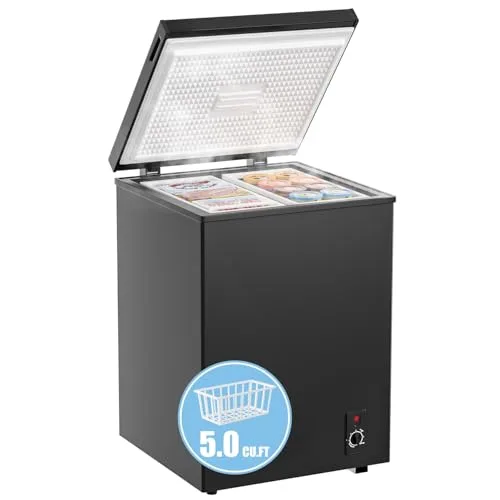
Bodacious Ultra-Quiet Chest Freezer
See real specs & live price →Chest vs. Upright: The Real Tradeoffs
Chest freezers typically use 10 to 25 percent less energy than upright models of similar capacity. The physics is simple: cold air is heavier than warm air, so it sinks and pools at the bottom of a chest freezer. Open the top lid, and that cold air mostly stays put. Open an upright's front door, and the heavy cold air spills straight out onto the floor, so the compressor has to work harder to replace it. Read September 6, 2026.
The tradeoff is organization and access — an upright's shelves make it easier to see and reach what you have, while a chest freezer needs more digging and, without a good basket system, can hide things at the bottom for months. Bodacious's chest freezers include two storage baskets on the 7.0 Cu Ft size specifically to soften that downside, while the mini upright freezer trades some of that energy efficiency for shelf-based organization in a much smaller footprint.
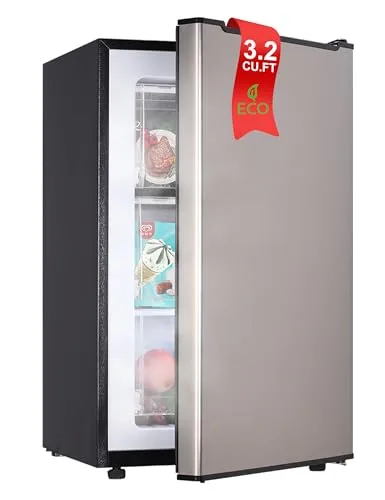
Bodacious 3.2 Cu Ft Mini Upright Freezer
See real specs & live price →The One Number Food-Safety Agencies Care About
Whatever size or shape you choose, the number that actually matters for safety is the temperature: both the FDA and USDA recommend keeping a freezer at 0°F (-18°C) or below. Food held at 0°F is considered safe to eat indefinitely from a bacterial-growth standpoint — freezing doesn't kill bacteria, but it stops them from multiplying. Quality (texture, taste, freezer burn) still declines the longer food sits, which is a separate question from safety. Read September 6, 2026.
Bodacious's chest freezers offer a 6-speed thermostat running from -0.4°F to 32°F, so reaching 0°F or below is a matter of turning the dial rather than something you have to hope for.
Matching a Freezer to Your Household
Putting the above together: a household of 1-3 people with modest bulk-buying habits fits comfortably in the 5.0 Cu Ft chest freezer; a household of 4+ or one that stocks up on meat and produce seasonally is better matched to the 7.0 Cu Ft; and anyone who just wants overflow space beyond a kitchen fridge — in a dorm, a small apartment, or a home office — is usually better served by the compact 3.2 Cu Ft mini upright, which trades capacity for a much smaller 17.5"D x 18.5"W footprint.
Keeping a Manual-Defrost Freezer Efficient
Neither Bodacious freezer self-defrosts, which is normal for chest and mini upright freezers at this price point and size — automatic defrost adds a heating element that itself uses extra energy. Frost buildup on the walls acts as insulation against the freezer's own cooling coils, so a freezer with a thick layer of frost has to run longer to hold the same temperature. Manufacturer guides typically recommend defrosting once the frost layer reaches about a quarter-inch, unplugging the unit, and letting the ice melt fully (Bodacious's own listing includes a drain port on the chest freezer specifically to make this easier) before restarting.
Sources
- FDA — "Are You Storing Food Safely?" — safe freezer temperature guidance. Accessed September 6, 2026.
- USDA Food Safety and Inspection Service — "Freezing and Food Safety". Accessed September 6, 2026.
- U.S. Department of Energy — "Purchasing Energy-Efficient Residential Freezers". Accessed September 6, 2026.
- Virginia Cooperative Extension — "Energy Series: What about Refrigerators and Freezers?" — chest vs. upright energy use. Accessed September 6, 2026.
The federal guidance and energy figures above are quoted or closely paraphrased from the public sources linked here — we didn't alter their substance. Everything else in this guide (how we'd size a freezer, which Bodacious model fits which household) is our own editorial judgment, not an official recommendation from the FDA, USDA or DOE.